Commentary
“The Gaza Envelope”
This is the final of three essays by my friend, Mickey Golbus, documenting his recent trip with his wife, Toni, to Israel. I am publishing these essays in Around the Block with his permission. (In the event you did not see the first two posts, here are the links to the first essay, “The Hostages.” https://around-the-block.com/2024/02/06/experiences-and-thoughts-from-israel-post-october-7th/ and the second, “The Day After” https://around-the-block.com/2024/02/08/experiences-and-thoughts-from-israel-post-october-7th-2/
The Gaza Envelope by Dr. Mitchell S. Golbus
Toni and I made another trip Thursday that I need to share with you. This was to the area the Israelis call the Gaza Envelope. It is the communities that surround and are close to Gaza. It was these communities that were attacked on Oct. 7th with 1200-1500 civilians and 400+ soldiers killed and 240 hostages taken back to Gaza.
Our first stop was at the field of cars. There is a square block area full of burned and destroyed cars-it is simply a mass of metal. Next to it is a field the size of two football fields with row after row of cars riddled with bullet holes, but still recognizable as cars.
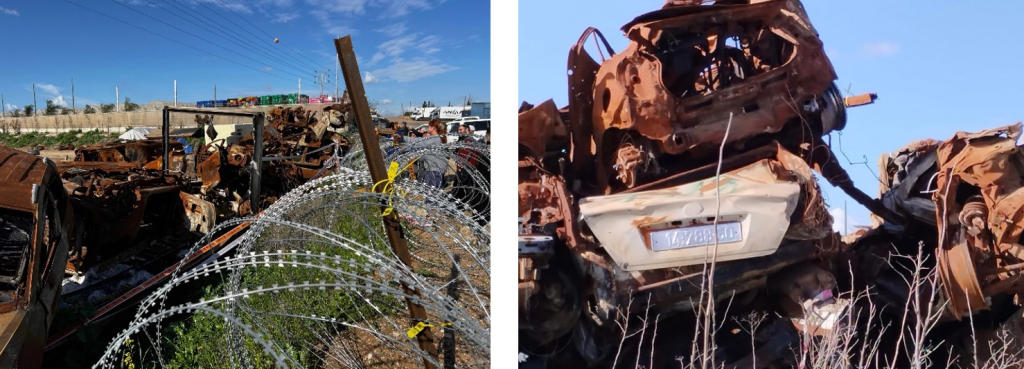
Standing there in awe, one gets the sense of the magnitude of the worst day for Jews since the Holocaust. We were told a story of one of the burned vehicles, an ambulance. The occupants were charred remains which were carefully removed. There was a necklace identified as belonging to Dafna and what could be extracted from the car was buried in a coffin by Dafna’s family. It is noteworthy that Israeli burials are in shrouds and a coffin is only used in time of war when the remains are incomplete or unrecognizable. Dafna had a close friend, Shira, who was never found and presumed to be among the hostages. The necklace was taken to a laboratory where the blood was scraped off and submitted to DNA analysis. The analysis showed that the remains were of both Dafna and Shira. The coffin was exhumed, the unrecognizable remains split into two parts and reburied so both families could have some closure.
Our next stop was at a moshav (community in which the means of production are held in common by all) that had been attacked. The survivors had been evacuated to a hotel near the Dead Sea. One man came back and set up a coffee stand to provide coffee to the soldiers going into and coming out of Gaza. Within a short time, people from all over the country had come and set up food stations, showers, a massage room (!), and other facilities for the soldiers.
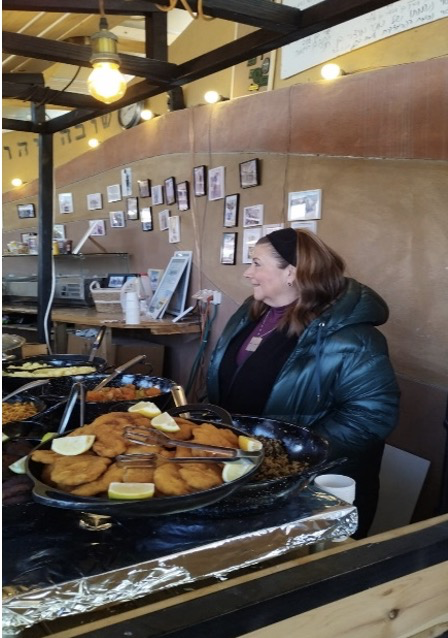
Many of the soldiers took the time to thank us for coming (it is incomprehensible to me how THEY could be thanking US).
To fully understand what is happening here, we must remind ourselves of the last year of Israel’s[MG1] history. A year ago, Bibi Netanyahu was elected as Prime Minister and established a far right-ultra religious-extremist coalition. Ministers (equivalent to U.S. Department Secretaries) were chosen based on loyalty to Bibi and allowed to run rampant with their departmental budgets. The civil service was replaced with friends who had no idea how to run a governmental agency. There was a concerted effort to weaken/nullify the courts with the further goal of limiting some civil rights. The citizens reacted by coming out into the streets. Every Saturday night (at the end of the Sabbath), hundreds of thousands of Israelis joined protests against the government. This was a huge coalition that reached across the far left, the left, the center, and even into the right, politically. This basic and formidable division of the country existed through Oct. 6th and abruptly ceased on Oct. 7th. Then they were all “just Israelis” and at war. But at this point the government did not know how to provide civil services-the 80,000 people who needed to be evacuated from the Gaza envelope, the 80,000 people who needed to be evacuated from the north (under Hezbollah rocket bombardment), the soldiers who needed to get to their units, the food needs, the psychological needs. And the citizens who had been taking to the streets now came out to fulfill the country’s needs. So, when I described the R&R site and services above, those were not governmental, they were the efforts of fellow citizens.
Our next stop was at Kibbutz (a socialized community where everything belongs to the community-perhaps the only successful example of communism) Beeri. This community had 97 citizens killed on Oct.7th. 300 Hamas terrorists surrounded the community and started the raping and slaughter. There are destroyed buildings everywhere.
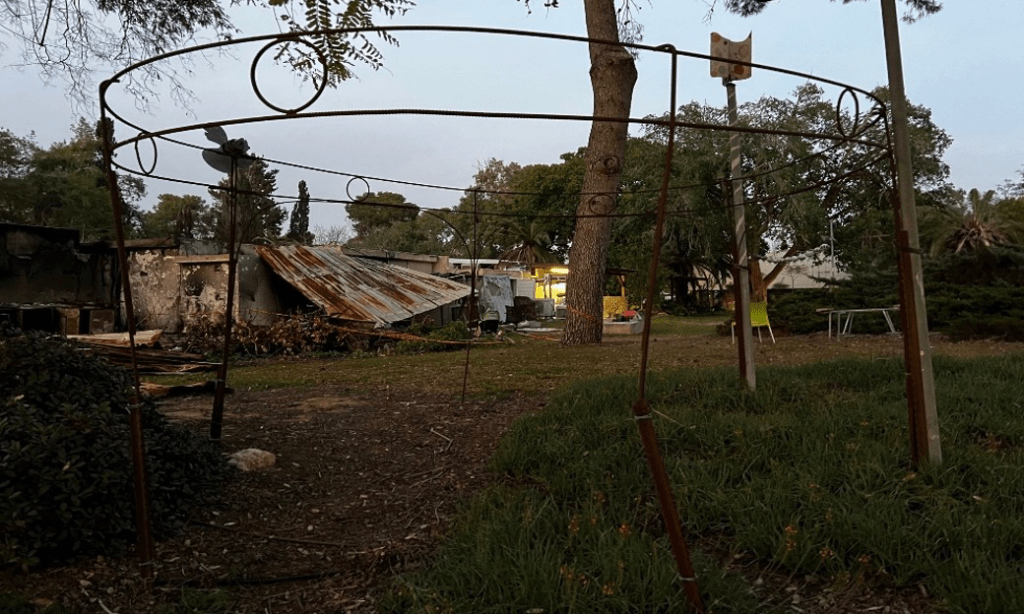
It took the IDF (Israeli army) two and a half days to clear the community of terrorists.
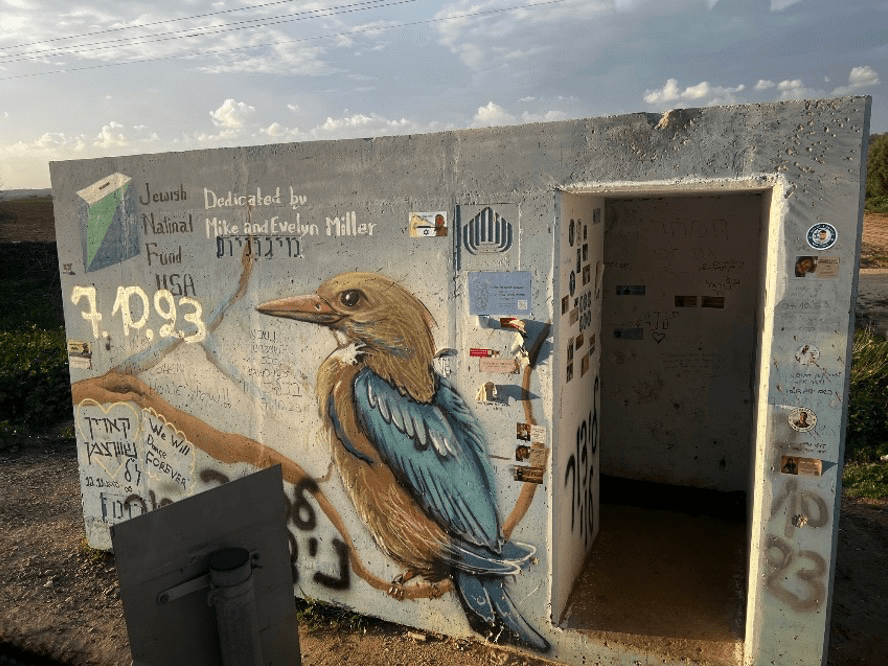
As we left this area, we passed a bomb shelter on the side of the road. These are common as there is only a 15 second warning between the sirens and the landing of a rocket from Hamas. This shelter was well known because on Oct. 7th fifteen people huddled inside with one reserve soldier at the doorway. The terrorists would throw a grenade into the shelter and the soldier threw it back out. This went on until the 8th grenade exploded. There were still 8 survivors who would not have lived without the bravery of that reservist.
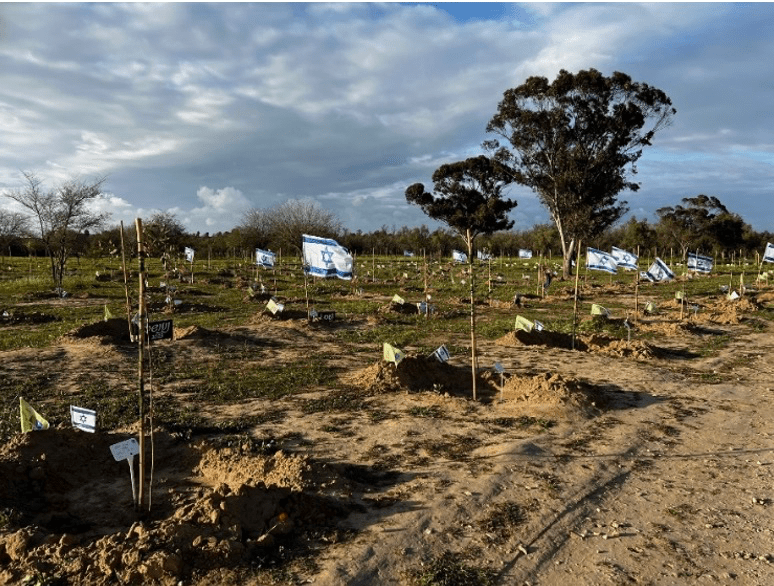
Our fourth stop was at the site of the Nova rave party attended by 3000 people in their 20’s and 30’s who had gathered for a weekend of music and dancing in the desert. A party rule that no weapons could be brought left them defenseless when the Hamas hordes arrived. 340 of these young people were killed and most of the 240 hostages were taken from this area. There are too many stories to tell of the heroism of ordinary Israelis who heard of the slaughter and went there in their own vehicles to rescue people. There is a field of 340 flags, each surrounded by special mourning candles (yahrzeit candles) to commemorate this loss. Recently, on Tu b’Shevat (the Hebrew New Year of the trees) the families of these young people came and each planted a tree in the memory of their loved one, producing a poignant new forest.
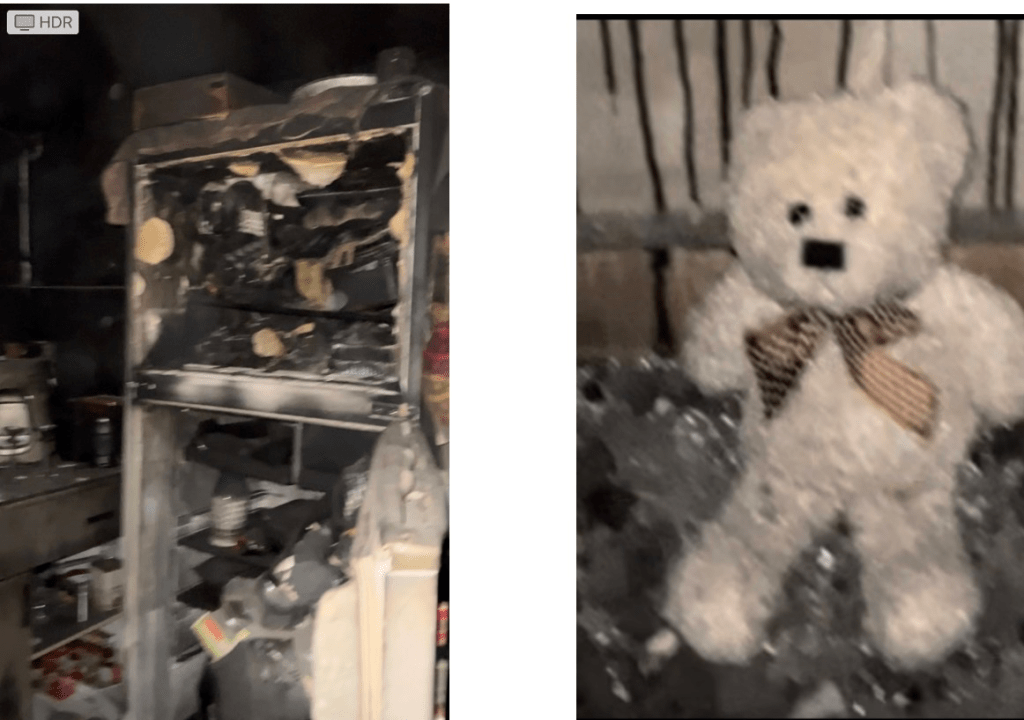
Our last stop was at Kibbutz Ner Oz. This was a community of 400 souls of whom 38 were killed and 75 taken hostage on Oct. 7th. We were allowed to visit one burned out home where the children’s coats were still on the hooks by the door, the singed teddy bear was on the floor, and everything within the house, including the refrigerator contents, had been burned to a crisp.
This uninhabitable community has been taken over as an advanced military staging area. We were one mile from Kahn Yunis (the largest city in southern Gaza) and could see the smoke and hear the explosions of the ongoing conflict. There were about a dozen soldiers here, one third of their unit. They were guarding the Kibbutz while the other two thirds of the unit were fighting in Gaza. They rotate with roughly ten days in Gaza and five days at the staging area. They told us they “just march to the battle as it is only a mile away.” A large bar-b-q was set up to do steaks, hamburgers, chicken, hot dogs, and vegetables. The first food was packed up to go in to their unit-mates in Gaza, the next fed the soldiers and the last fed us.
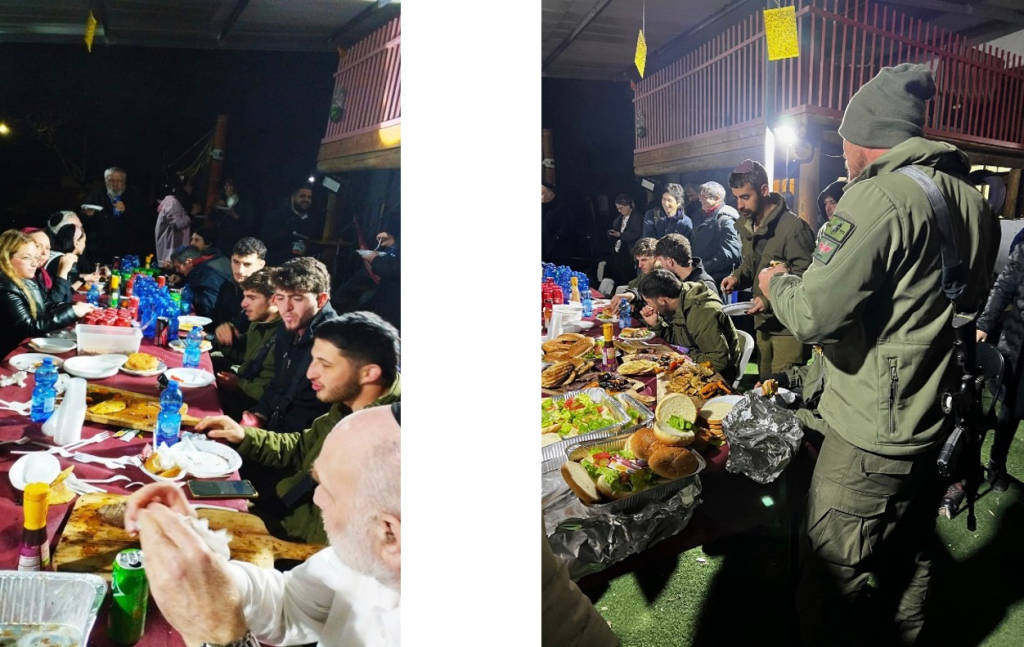
We ate and talked to them. They were baby-faced, open in their conversation, and kept thanking us for coming. On the way out of the kibbutz we were taken to a small area where they are launching observation drones. The drones look like large model airplanes and are equipped with three cameras. A team of two send the drone up and over Gaza, and a team of two there take control and direct it to exactly where the observation is needed.
This day was very difficult and emotionally overloading. The tremendous loss of life and the creation of the hostage situation has left an unimaginable burden on the psyche of every Israeli (and many of us). The world will forever be split into before Oct. 7th and after Oct. 7th. This, however, contrasts with most of the world who have already forgotten Oct. 7th and can only talk about Oct. 8th.
I have another difficult and controversial concept that I must share. It is not well known in the “outside world” that on Oct. 7th, in addition to the hordes of Hamas terrorists who invaded Israel, over 1000 ordinary Palestinian citizens followed them in to Israel. They mostly came to rob, but many digressed to rape and kill. The hostages were not all taken by Hamas. Some were taken by Islamic Jihad (another terrorist group), and some were taken by these ordinary Palestinians and are being held without Hamas knowing where they are being kept. On Oct. 7th when all the hostages were taken to Gaza, they were met by mobs of Palestinians who spat on them, beat them, and tried to further degrade them. These pictures have been well publicized in Israel. This makes it very hard for Israelis to have great sympathy for the Palestinians currently. Between the terror they feel for their lives, the fear for the hostages, and the revulsion at the Palestinians, there is very little room for other thoughts.
Mitchell S. Golbus, M.D., is Professor Emeritus, UCSF School of Medicine and resides with his wife in San Rafael.
 Around the Block
Are you able to follow this up with his thoughts today, four months removed?
LikeLike