Commentary
I turned to Thomas Friedman and Sir Martin Gilbert – but received little solace.
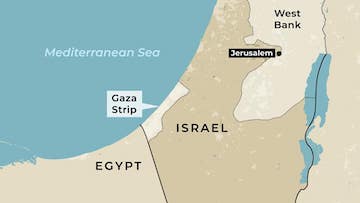
As Israel’s war against Hamas in Gaza continues, with the prospect of a two-front war with Hezbollah in the north or even a three-front war as anti-Israel activity begins to move from a simmer to a boil in the West Bank, I, like many Jews, am at a loss for what to do and what to think.
In times like this, and there have been many times like this, I tend to rely on the opinions of Thomas L. Friedman of The New York Times. For those not familiar with his work, Friedman is a three-time Pulitzer Prize winner who is a weekly columnist for The New York Times. He has written extensively on foreign affairs, global trade, the Middle East, globalization, and environmental issues. Friedman’s first book, “From Beirut to Jerusalem (1989) chronicles his days as a reporter in Beirut during the Lebanese Civil War and in Jerusalem through the first year of the Intifada. Friedman wrote a 17-page epilogue for the first paperback edition concerning the potential for peaceful resolution in Israel and Palestine. Needless to say, writing about such fraught, intractable situations as the events in Israel and the mid-East, has rewarded Friedman criticisms from both sides.
His latest column cannot be more heartfelt – or more depressing. Here are some excerpts:
“People warned me before I came to Tel Aviv a few days ago that the Israel of Oct. 7 is an Israel that I’ve never been to before. They were right. It is a place in which Israelis have never lived before, a nation that Israeli generals have never had to protect before, an ally that America has never had to defend before — certainly not with the urgency and resolve that would lead a U.S. president to fly over and buck up the whole nation.
“After traveling around Israel and the West Bank, I now understand why so much has changed. It is crystal clear to me that Israel is in real danger — more danger than at any other time since its War of Independence in 1948.“
In typical Friedman logical style, he lists three reasons why that danger is worse, more palpable than at any time in his experience covering the region.
“First, Israel is facing threats from a set of enemies who combine medieval theocratic worldviews with 21st- century weaponry — and are no longer organized as small bands of militiamen but as modern armies with brigades, battalions, cybercapabilities, long-range rockets, drones and technical support. I am speaking about Iranian-backed Hamas, Hezbollah, Islamic militias in Iraq and the Houthis in Yemen — and now even the openly Hamas-embracing Vladimir Putin. These foes have long been there, but all of them seemed to surface together like dragons during this conflict, threatening Israel with a 360-degree war all at once.
“How does a modern democracy live with such a threat? This is exactly the question these demonic forces wanted to instill in the mind of every Israeli. They are not seeking a territorial compromise with the Jewish state. Their goal is to collapse the confidence of Israelis that their defense and intelligence services can protect them from surprise attacks across their borders — so Israelis will, first, move away from the border regions and then they will move out of the country altogether.
“The second danger I see is that the only conceivable way that Israel can generate the legitimacy, resources, time and allies to fight such a difficult war with so many enemies is if it has unwavering partners abroad, led by the United States. President Biden, quite heroically, has been trying to help Israel with its immediate and legitimate goal of dismantling Hamas’s messianic terrorist regime in Gaza — which is as much a threat to the future of Israel as it is to Palestinians longing for a decent state of their own in Gaza or the West Bank.
“But Israel’s war against Hamas in Gaza entails urban, house- to-house fighting that creates thousands of civilian casualties — innocent men, women and children — among whom Hamas deliberately embedded itself to force Israel to have to kill those innocents in order to kill the Hamas leadership and uproot its miles of attack tunnels.
“But Biden can sustainably generate the support Israel needs only if Israel is ready to engage in some kind of a wartime diplomatic initiative directed at the Palestinians in the West Bank — and hopefully in a post-Hamas Gaza — that indicates Israel will discuss some kind of two-state solutions if Palestinian officials can get their political house unified and in order.
“This leads directly to my third, deep concern.
“Israel has the worst leader in its history — maybe in all of Jewish history — who has no will or ability to produce such an initiative.
“Worse, I am stunned by the degree to which that leader, Prime Minister Benjamin Netanyahu, continues to put the interests of holding on to the support of his far-right base — and pre-emptively blaming Israel’s security and intelligence services for the war — ahead of maintaining national solidarity or doing some of the basic things that Biden needs in order to get Israel the resources, allies, time and legitimacy it needs to defeat Hamas.“
Finally, someone with the knowledge and the history of Israel and its “neighborhood,” a word Friedman often uses euphemistically to explain the region, speaks out about Netanyahu. I, for one, have been saying, during the many years that Netanyahu has ruled Israel with his unholy coalition, “If there is an Israel in 30 years, the history of that time will say, ‘Benjamin Netanyahu will go down as the worst prime minister in Israel’s history.” I’m frightened now that my 30 year time frame might have been too optimistic!
I’ve attached Friedman’s column for you to read.
But I need to excerpt two more quotes from that column:
- “The sooner Israel replaces Netanyahu and his far-right allies with a true center-left-center-right national unity government, the better chance it has to hold together during what is going to be a hellish war and aftermath.”
- “This society is so much better than its leader. It is too bad it took a war to drive that home.“
Perhaps Tom Friedman is right – removing Netanyahu from the scene might facilitate a better end to this current, existential crisis.
But, is it as simple as that?
Sir Martin John Gilbert (original family name, Goldberg) was a British historian. He was the author of eighty-eight books, including works on Winston Churchill, the 20th century, and Jewish history. I am currently reading his incomparable* book, “Israel: A History,” published in 1998.

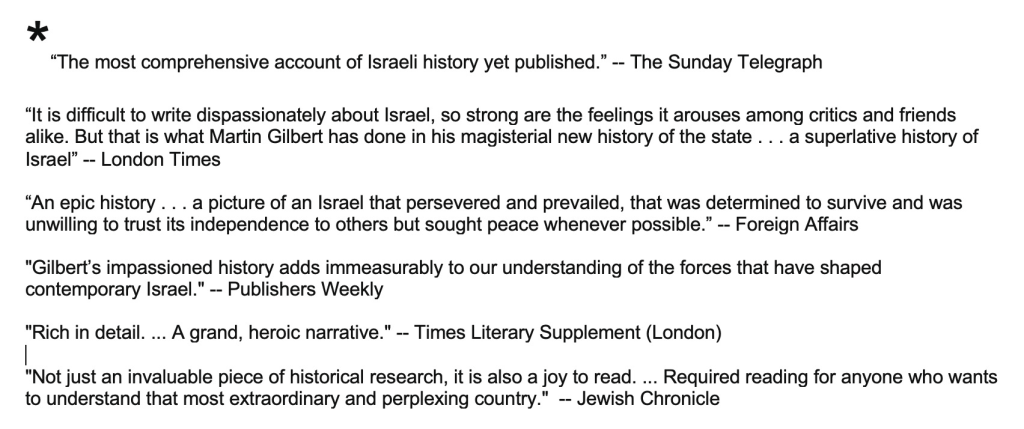
Chapter Four of “Israel: A History” is titled, “Threats and dangers: 1929-1937.” Here are some passages from that chapter.
“There was a second strand of Arab disaffection, which had long preceded the enlargement of the Jewish Agency, and which was exacerbated during the summer of 1929. Throughout the first six months of 1929, Jewish prayers at the Wailing Wall had continued to be a focus of Arab protest.
“On June 11, the (British) High Commissioner wrote to the Mufti defending the right of the Jews ‘to conduct their worship’ as in the past. But growing tension between the two communities led, on August 23, to an attack by large crowds of Arabs on individual, unarmed Jews in the Old City of Jerusalem. According to the subsequent British commission of inquiry, ‘large sections of these crowds were bent on mischief, if not on murder’. When news of the violence in Jerusalem reached Hebron, the Jewish school there was attacked, and a Jew killed. On August 25 a large Arab crowd made what the official British report described as ‘a most ferocious attack’ on the Jewish Quarter. ‘This savage attack, the report continued, ‘of which no condemnation can be too severe, was accompanied by wanton destruction and looting. Within five hours, more than sixty Jews had been killed, including many women and children.
“The Arab violence spread rapidly. The kibbutz at Beit Alpha -where the ancient synagogue mosaic had been excavated seven months earlier -was among those that had to beat off Arab attacks. In the village of Motza, just outside Jerusalem, six members of one family were killed, including two children, and their bodies muti-lated. On August 26, ‘Arab mobs’, as the British report described them, killed and wounded forty-five Jews in the northern town of Safed. In the suburbs of Jerusalem, 4,000 Jews were forced to leave their homes, many of which were looted. When the attacks ended at nightfall on August 29, the number of Jews killed throughout Palestine was 133. Eighty-seven Arabs had also died, mostly shot by British troops and police seeking to halt the violence. ‘In a few instances’, the official report noted, ‘Jews attacked Arabs and destroyed Arab property. These attacks, though inexcusable, were in most cases in retaliation for wrongs already committed by Arabs.’
“The killing in Palestine came to an end, but the anti-Jewish propaganda continued. A Jerusalem Arab students’ leaflet which was widely circulated on 11 September 1929 declared: ‘O Arab! Remember that the Jew is your strongest enemy and the enemy of your ancestors since olden times. Do not be misled by his tricks, for it is he who tortured Christ (peace be upon him), and poisoned Mohammed (peace and worship be with him). The leaflet urged an Arab boycott of all Jewish shops and trade in order ‘to save yourself and your Fatherland from the grasp of the foreign intruder and greedy Jew’.
“The British were well aware of the nature of Arab propaganda. As early as September 5 the officer commanding the British troops in Palestine telegraphed to the War Office in London with details of a manifesto ‘full of falsehoods and inflammatory material which has been issued to Moslems in other countries’. Two weeks later, on September 29, the High Commissioner, Sir John Chancellor, telegraphed from Jerusalem to the Colonial Office in London: ‘The latent deep- seated hatred of the Arabs for the Jews has now come to the surface in all parts of the country.
“Threats of renewed attacks upon the Jews are being freely made and are only being prevented by the visible presence of considerable military force.’
“…on September 29, the High Commissioner, Sir John Chancellor, telegraphed from Jerusalem to the Colonial Office in London: ‘The latent deep-seated hatred of the Arabs for the Jews has now come to the surface in all parts of the country. Threats of renewed attacks upon the Jews are being freely made and are only being prevented by the visible presence of considerable military force.’
“The High Commissioner went on to point out, ‘Propaganda against immigration of Jews into Palestine has recently been conducted amongst Arabs in neighbouring countries on an xtensive scale, and if there is any recrudescence of the disturbances in Palestine it is doubtful if incursions into Palestine by Arabs from beyond the frontier could again be prevented.’
“On the very day of this warning of Arab pressures outside Palestine, the President of the
Arab Executive in Palestine, Musa Kazim Pasha, warned a senior British official that unless the Jewish National Home policy was changed, ‘there would be an armed uprising’ among the Arabs. Musa Kazim Pasha added that such an uprising would involve, not only the Arabs of Palestine but ‘participation of Moslems from Syria, Transjordan and perhaps Iraq.’ It looked as if the Arab hostility to the Jews would lead to full-scale war.
“In a further telegram to London on October 12, the High Commissioner pointed out that the Arabs of Palestine had recently obtained ‘a considerable number of arms’ from both Transjordan and the Hedjaz. Further arms were known to have entered the country from Syria. On October 26 a British police report warned that ‘gangs of criminals, to attack Jews and British officials, have been formed, and will first function in areas at Haifa and Nablus’.
“The Jews were shaken by the intensity of the Arab violence, but were determined not to surrender all that they had created in the past fifty years. On October 25, after a visit to one of the Jewish villages which had been attacked by the Arabs, Arthur Ruppin* wrote in his diary, ‘On Tuesday, I went from Tel Aviv to visit Hulda, most of which was destroyed and burnt to ashes during the disturbances. Many of the trees have also been burnt. There is nobody there. The place makes a terrible impression. I remembered what hopes we had when we built the first house there twenty years ago. But I was not depressed: we shall rebuild what has been destroyed. On the whole, it is strange that I am one of the few optimists. I have a profound mystical belief that our work in Palestine cannot be destroyed.’
*German Zionist proponent, the director of the Palestine Office of the Zionist Organization in Jaffa, organizing Zionist immigration to Palestine.
“In Ruppin’s view, the Jewish community in Palestine would not only continue to exist, but would also ‘animate Jewry in the Diaspora’ to support it, and to build it up with funds and peo- ple. Ruppin also supported an organization set up to try to bridge the gap between Jews and Arabs by proposing a bi-national State in Palestine, one in which Jews and Arabs would have an equal share in the administration, regardless of the size of their respective populations, intermixed geographically, and with no borders between their various communities. The organization, set up in 1925, was called Brit Shalom (Covenant of Peace). One of its leading lights was the first Chancellor of the Hebrew University, San-Francisco-born Judah Magnes.
“But the idea of a bi-national State was not to the liking of the Zionist leaders. In December 1929, at a meeting with Brit Shalom, Ben-Gurion explained his opposition: ‘Our land is only a small district in the tremendous territory populated by Arabs-most sparsely populated, I might add. Only one fragment of the Arab people- -perhaps 7 or 8 per cent, if we take into account only the Arabs of the Asian countries lives in Palestine. However, this For the entire Jewish nation this is the one and only country with which are connected its fate and future as a nation. Only in this land can it renew and maintain its independent life, its national economy and its special culture, only here can it establish its national sovereignty and freedom. And anyone who blurs this truth endangers the survival of the nation.“
As Ben-Gurion argued at that meeting in 1929, the “idea of a bi-national State” was a non-starter, and an obvious one: What would be the difference for Jews in Palestine living as the minority in country in which they’re not wanted? How different would that be from Jews living in Germany, Poland and Romania?
But there was another solution – the two-state solution. As Gilbert writes in Chapter 5, Hopes…and blows: 1937-1939:
“The year 1937 was to be a decisive one for the Jews of Palestine. It was believed that the Peel Commission* would suggest the creation of two independent States in Palestine, one Jewish and the other Arab. The concept of partition put the enticing prospect of statehood before the Jews. At the same time, they feared the danger – from their perspective – a truncated area of control. Even as the Peel Commissioners, having returned to Britain, continued to take evidence, the Zionists persevered with the establishment of new settlements.“
*The Peel Commission was a British Royal Commission of Inquiry, headed by Lord Peel, appointed in 1936 to investigate the causes of unrest in Mandatory Palestine, which was administered by Great Britain, following a six-month-long Arab general strike.
There’s an old saying…”history repeats itself.” Could there be any more evidence of that shibboleth than these from Israel: A History:
- Arab violence;
- Anti-Jewish propaganda;
- Latent deep-seated hatred of the Arabs for the Jews;
- Manifestos full of falsehoods and inflammatory material which has been issued to Moslems in other countries;
- Proposals and rejections of a two-state solution;
- Zionists persevering with the establishment of new settlements.
And, remember, I’m only discussing the period up to 1939!
Let me end with where I began – I, like many Jews, am at a loss for what to do and what to think. And I haven’t even touched on the rise of antisemitism this “war” has created here and around the world. Or the crisis Jewish students are facing at some of the most elite colleges and universities in America, including Cornell, where a cousin’s older daughter attends.
Here are some of the posts from her fellow classmates:
“If you see a jewish ‘person’ on campus, follow them home and slit their throats. rats need to be eliminated from cornell.”
“…the genocidal fascist zionist regime will be destroyed. rape and kill all the jew women, before they birth more jewish hitlers. jews are excrement on the face of the earth. no jew civilian is innocent of genocide.”
“…gonna shoot up 104 west,” referring to the kosher dining hall on campus.
“If i see another synagogue another rally for the zionist globalist genocidal apartheid dictatorial entity known as ‘israel’, i will bring an assault rifle to campus and shoot all you pig jews,” one user posted. “Jews are human animals and deserve a pigs death.”
Depressed?
Sorry. Not anymore than I am!
 Around the Block
What an uplifting message.
Went to a Sausalito park with tables and chairs set for Shabbat dinner by the 240 hostages. Being done today at 5-6 places around the Bay Area.
shabbat shalom
.
LikeLike
Hi Ted,
<
div>This is an excellent piece. You’ve really captured wh
LikeLike
Thanks, Ted, I had trouble opening this the other day but today it worked. I haven’t read the history by Sir Martin Gilbert. Another book to add to my stack. I also had missed Friedman’s column although I had been told about it. Nothing really new but an exclamation point on all of it. Martin’s history had details that I was unaware of Friedman not so much. it is so much worse than a conundrum for the military and may Bibi be sent to the valley of Gehenna!!! Thanks for putting this out there. Toni
>
LikeLike